


Every parent hits this crossroads at some point. Your child is learning to write, school is sending home practice worksheets, and somewhere in the back of your mind a question starts forming: should my child be spending this time on typing instead? Or is cursive still worth the effort?
It is a genuinely hard call. The answer depends on your child’s age, their learning style, what their school requires, and what skills actually matter most for where education is heading. This guide walks through the research, lays out an honest comparison, and helps you figure out the right approach for your kid specifically.
We covered the broader debate about whether cursive belongs in schools at all in our article on the 5 reasons why cursive should not be taught in schools. This guide goes one level deeper: what should your child prioritize, and when?
Quick Answer
Children benefit most from learning print handwriting first (ages 4 to 7), followed by typing skills (ages 6 to 8 onward). Cursive, if taught at all, is best introduced after a child is already comfortable with both print and basic keyboarding. Typing proficiency has more direct academic and career relevance in the modern world. Handwriting (print) still matters for cognitive development. Cursive is optional for most children.
Why This Question Matters More Than Ever
A generation ago, the path was obvious: print letters in kindergarten, cursive in third grade, typing class in middle school. That sequence made sense when most adult work happened on paper.
Now the order is scrambled. Many children use school-issued tablets or Chromebooks starting in second or third grade. Standardized tests in many states are moving online. Most written work submitted for jobs, college applications, and professional settings is typed.
At the same time, research on the cognitive benefits of handwriting has gotten more attention. Studies from neuroscientists have found that writing by hand activates areas of the brain that typing does not. A 2020 high-density EEG study published in Frontiers in Psychology found that cursive handwriting and drawing engaged more neural connectivity than typewriting, particularly in children.
So both sides have real evidence. The key is understanding what the evidence actually says, rather than letting either camp overstate it.
What the Research Says About Handwriting vs. Typing
Here is what is well established:
Writing by hand supports memory and letter recognition. Studies consistently show that children who trace and write letters by hand remember them longer and recognize them more accurately than children who only type them. This matters most in the early years (ages 4 to 7) when the brain is building foundational literacy pathways.
Note-taking by hand beats typing for understanding. Research from Princeton and UCLA found that students who take notes by hand during lectures understand concepts better than those who type. Typing tends to produce verbatim transcription; handwriting forces the brain to process and restate.
These benefits apply to handwriting in general, not cursive specifically. This is the important nuance. The cognitive uplift comes from the act of forming letters by hand. Print handwriting produces the same brain engagement as cursive. There is no strong evidence that cursive provides additional cognitive benefit beyond what print already gives.
Typing has its own benefits once mastered. When keyboarding becomes automatic, students can focus on content rather than letter formation. Research cited by the Yale Center for Dyslexia notes that students with reading and writing difficulties significantly increase their output, clarity, and spelling accuracy after switching to keyboarding.
The Age-by-Age Breakdown
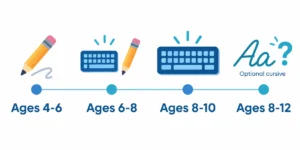
Ages 4 to 6: Print Handwriting First
At this stage, the goal is letter recognition and fine motor development. Children should be tracing and writing print letters. Handwriting at this age directly supports reading. It is too early for typing to be the primary writing mode, and cursive is far too complex for developing motor skills.
Ages 6 to 8: Introduce Typing Alongside Print
By first or second grade, children who are comfortable with print letters can start learning basic keyboard awareness. This does not mean replacing handwriting. It means building familiarity with key positions, finger placement, and simple typing games. Many schools begin here.
Ages 8 to 10: Build Typing Proficiency
By third grade, most academic work starts requiring typed submissions. A child who cannot type reasonably well is at a real disadvantage. This is the window to build genuine keyboarding skill. Typing programs like Typing.com, Dance Mat Typing, or Nitro Type work well for this age group.
Ages 8 to 12: Cursive, If at All
If your school requires cursive, or your child is curious about it, this is the right age range. A child who is already confident in print and has solid basic typing skills can add cursive without it competing with more critical foundations. If cursive is not required and your child is not interested, the time genuinely is better spent elsewhere.
Typing vs. Cursive: A Direct Comparison
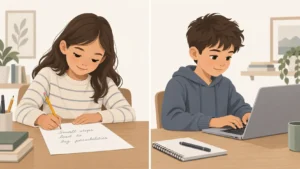
A side-by-side look at how these two skills compare across the factors that matter most for children today:
| Factor | Typing | Cursive |
| Real-world use (adult life) | Used daily in almost every career | Rarely used beyond signatures |
| Academic requirement | Required from grade 3 onward in most schools | Mandated in only 25 states |
| Cognitive development | Good once automatic; limited during learning phase | Similar to print for brain engagement |
| Accessibility for learning differences | Better for dyslexia, dysgraphia, ADHD | More difficult for many learners |
| Time to useful proficiency | 3 to 6 months of regular practice | 1 to 2 full school years |
| Career relevance | Essential in virtually all fields | Marginal in almost all fields |
What About Kids With Learning Differences?
For children with dyslexia, dysgraphia, or ADHD, the typing-first approach is especially important. Struggling with letter formation in cursive adds a physical and cognitive barrier on top of an already challenging process. Keyboarding removes that barrier.
If your child has a formal diagnosis or suspected learning difference, talk to their teacher or occupational therapist about the right sequence for them. For a deeper look at how handwriting challenges specifically affect children with learning differences, read our guide on learning differences and handwriting: what parents should know.
What Parents Can Do at Home
For younger children (4 to 7):
- Practice print letter formation with wide-ruled paper and large pencils
- Use letter tracing apps with tactile feedback
- Keep sessions short: 10 to 15 minutes is enough for this age
For school-age children (7 to 11):
- Set up a free typing program and aim for 15 minutes of practice three times per week
- Do not force cursive if school does not require it
- If cursive is required, treat it as one skill among many rather than a priority
For all ages:
- Model good typing posture: feet flat, back straight, wrists neutral
- Celebrate progress in typing speed without making it stressful
- Keep some handwriting in the routine for the cognitive benefits, even if it is just journaling or lists
The Bottom Line
Typing is not the enemy of handwriting, and handwriting is not the enemy of typing. They serve different purposes at different stages.
The practical answer for most families is: prioritize print handwriting in the early years for cognitive development and literacy, shift focus to typing from around second grade onward for academic and career readiness, and treat cursive as optional unless your school or your child’s interests make it relevant.
For a broader look at where the education debate on cursive currently stands, see our full breakdown of why cursive should not be taught as a mandatory school subject. And if your child has specific writing challenges, our guide on digital literacy for elementary students covers the full picture of what technology skills children need today.
Frequently Asked Questions
At what age should kids start learning to type?
Most children are ready to begin basic keyboard familiarity around ages 6 to 7. Structured typing practice, with a goal of building real speed and accuracy, works best from ages 8 to 10.
Is typing better than cursive for brain development?
Neither is better than the other for brain development specifically. Handwriting (print or cursive) has stronger benefits for memory and letter recognition in early childhood. Typing has practical benefits once it becomes automatic. The two serve different cognitive and practical purposes.
Should kids still learn to write by hand?
Yes. Print handwriting remains important for early literacy, fine motor development, and memory. The question is not handwriting versus typing. It is about which form of handwriting (print vs. cursive) deserves instructional time alongside typing.
Does cursive help kids with dyslexia?
The evidence is mixed. Some occupational therapists recommend cursive for dyslexic learners because the connected flow reduces letter reversals. However, most current research, including guidance from the Yale Center for Dyslexia, suggests keyboarding produces better writing outcomes for most students with reading differences.
How fast should a child be able to type?
A reasonable benchmark: 20 words per minute by end of fourth grade, 30 to 40 by end of sixth. Speed matters less than accuracy and comfort at the keyboard.
Sources: Frontiers in Psychology (2020 EEG study on handwriting vs. typing), NPR Health (2024, handwriting and brain research), Yale Center for Dyslexia via Ladder Learning Services, National Education Association.