


Look closely at the necks of Catholics in any parish, in any country, and you will likely spot a small oval medal: Mary standing on a globe, rays of light streaming from her hands, and a short prayer circling the edge. It is the Miraculous Medal, and it may be the most widely worn devotional object in the Catholic world.
But it is far more than religious jewelry. Behind this little medal stands a remarkable story, a direct promise from the Mother of God, and nearly two centuries of reported graces, healings, and conversions. Here are 5 reasons to wear the Miraculous Medal every day, and the beautiful story of where it came from.
Why Wear the Miraculous Medal? (Quick Answer)
Catholics wear the Miraculous Medal because of Mary’s promise to Saint Catherine Laboure in 1830: all who wear it with confidence will receive great graces. The medal is a sign of faith and consecration to Mary, an invitation to her intercession and protection, a miniature Gospel told in symbols, and a link to millions of believers and saints who have worn it for nearly 200 years. It is a sacramental, not a charm: its power lies in faith and prayer, not in the metal itself.
The Story Behind the Medal: Paris, 1830
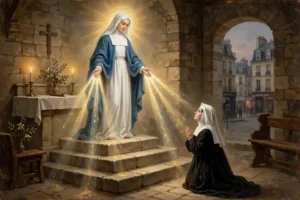
In 1830, a young novice of the Daughters of Charity named Catherine Laboure was serving at the motherhouse on the Rue du Bac in Paris. On the night of July 18, she was awakened by a luminous child, believed to be her guardian angel, who led her to the chapel. There, the Blessed Virgin Mary appeared and spoke with her for two hours, telling her that God wished to entrust her with a mission.
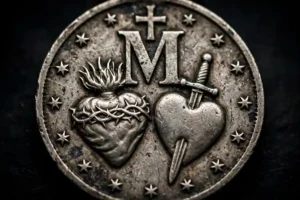
The mission was revealed on November 27, 1830, during evening meditation. Catherine saw Mary standing on a globe, her foot crushing a serpent, with dazzling rays of light streaming from rings on her fingers. Around the image appeared the words: “O Mary, conceived without sin, pray for us who have recourse to thee.” Then Catherine saw the reverse design: the letter M surmounted by a cross, and beneath it two hearts, one crowned with thorns and one pierced by a sword, all encircled by twelve stars.
Mary asked her to have a medal struck on this model, and she attached a promise to it: those who wear it, especially around the neck, will receive great graces, and graces will abound for those who wear it with confidence.
Catherine told only her confessor. With the approval of the Archbishop of Paris, the first medals were struck in June 1832 by the goldsmith Adrien Vachette, and they spread rapidly through a Paris gripped by a cholera epidemic. Reports of cures, protections, and conversions poured in. The medal was first called the Medal of the Immaculate Conception, but the people gave it a new name because of the favors they received: the Miraculous Medal. An official Church inquiry approved the apparitions in 1836.
Two details make the story even more striking. First, Catherine kept her identity secret for 46 years, quietly serving the elderly poor, and only revealed herself as the visionary shortly before her death in 1876. She was canonized in 1947. Second, in 1842 a skeptical young Jewish man named Alphonse Ratisbonne accepted a Miraculous Medal on a dare in Rome, and days later experienced a sudden vision of Our Lady that led to his conversion; the Church investigated and declared it miraculous. You can read more about the medal’s origins at the Basilica of the National Shrine of the Immaculate Conception.
Reason 1: It Carries Mary’s Promise of Great Graces
The first reason to wear the Miraculous Medal is the simplest: Mary herself promised graces to those who wear it.
During the apparition, Catherine noticed something puzzling. Some of the gems on Mary’s fingers shone with rays of light, and others did not. Mary explained that the rays symbolize the graces she sheds upon those who ask for them, while the dark gems are the graces for which souls forget to ask. It is one of the most tender details in all of Marian devotion: heaven has more grace to give than we bother to request.
Wearing the medal, then, is a way of asking, constantly. It turns an ordinary day into a standing prayer for grace. And the promise attached to it is not small: great graces for all who wear it, and abundant graces for those who wear it with confidence.
If you want to understand just how sufficient God’s grace is for every weakness and trial, our article on 5 reasons God’s grace is sufficient explores the promise of 2 Corinthians 12:9 in depth. The Miraculous Medal is like that promise made wearable: a daily reminder that grace is available, abundant, and only waiting to be asked for.
“All who wear it will receive great graces. Graces will abound for those who wear it with confidence.”
*Mary’s promise to Saint Catherine Laboure, November 27, 1830 (as recorded by Catherine)*
Reason 2: It Is a Daily Sign of Faith and Consecration
A medal worn daily becomes a quiet act of consecration. Each morning, putting it on is a small “yes” to God, a way of placing the whole day under Mary’s care and Christ’s lordship before the day has a chance to go sideways.
It is also a witness. The Miraculous Medal is instantly recognizable to Catholics everywhere, and it not infrequently starts conversations with people who are curious, searching, or quietly returning to the faith. Many wearers say the medal has opened doors to talk about God that they never would have opened themselves.
Saint Maximilian Kolbe understood this well. In 1917 he founded the Militia Immaculatae, a movement of total consecration to Mary, and he made the Miraculous Medal its insignia, recommending that members wear it as an external sign of their consecration. Mindful of Mary’s promise to Saint Catherine, he saw the medal as a safeguard of that consecration and a means of bringing grace to others. EWTN tells the story of Kolbe and the medal here.
A sign does not have to be loud to be powerful. Sometimes a small oval of metal, worn faithfully for years, preaches more than words ever could.
Reason 3: It Invites Mary’s Intercession and Protection
Catholics ask Mary to pray for them the way any Christian asks a friend to pray for them, except that this friend is the Mother of Jesus, who stands closer to Him than anyone. The medal is an invitation to that intercession, worn close to the heart.
Notice that the invitation is written right on the medal itself: “O Mary, conceived without sin, pray for us who have recourse to thee.” To wear the medal is to carry that prayer on your person all day, and to say, in effect: Mother, I am having recourse to you. Pray for me.
Down the centuries, wearers have testified to feeling Mary’s protection in danger, illness, temptation, and grief. Whether in a hospital room, on a battlefield, or in the ordinary dangers of a commute, the medal reminds the wearer that they do not face life alone and unaccompanied.
One clarification matters here, and the Church is careful about it. The medal is a sacramental, not a magic talisman. Sacramentals do not work automatically; as the Catechism teaches, they prepare us to receive grace and dispose us to cooperate with it (CCC 1670). The power is never in the metal. It is in the faith of the wearer, the prayer of the Church, and the intercession of Mary, who always leads her children to her Son.
“O Mary, conceived without sin, pray for us who have recourse to thee.”
*The prayer inscribed on the Miraculous Medal*
Reason 4: Its Symbols Preach the Gospel
The Miraculous Medal is a tiny catechism. Nearly every element of the design teaches something, which is why it rewards a slow look. The Catholic Company’s guide to the medal’s meaning walks through the design in detail.
On the front: Mary stands on a globe, Queen of Heaven and Earth, her foot crushing a serpent. The serpent is Satan, defeated by Mary’s obedience, just as Genesis 3:15 foretold that the offspring of the woman would strike the serpent’s head. The rays from her hands are the graces she obtains for those who ask. The date 1830 marks the year of the apparitions.
On the reverse: a large M is surmounted by a cross, showing Mary and Jesus inseparably joined in the work of salvation. Below are two hearts: the Sacred Heart of Jesus, crowned with thorns, and the Immaculate Heart of Mary, pierced by a sword, exactly as Simeon prophesied in Luke 2:35. Twelve stars surround the design, recalling both the twelve Apostles and the woman of Revelation 12, clothed with the sun and crowned with twelve stars.
Even the prayer on the front is theology in miniature. “Conceived without sin” points to the Immaculate Conception, a truth the Church would formally define as dogma in 1854, twenty-four years after an uneducated novice in Paris saw those words written in light around the Virgin.
Reason 5: It Connects You to Saints and Believers Worldwide
When you put on a Miraculous Medal, you join a very large company. Within a few decades of 1832, millions of medals had been distributed worldwide, carried by soldiers, sailors, nurses, missionaries, and mothers tucking them into their children’s clothing. The Daughters of Charity spread the devotion on every continent, and parishes, hospitals, and schools still distribute the medal today.
The saints loved it too. Saint Maximilian Kolbe distributed medals constantly and made the medal the badge of his movement, calling on his Knights of the Immaculata to wear it daily. Mother Teresa was well known for giving Miraculous Medals to the people she met and served, pressing them into hands with a smile and a blessing. Saint Catherine herself, of course, is the quietest member of this company: the woman who gave the medal to the world asked for nothing, not even recognition, in return.
There is something deeply consoling in that fellowship. The same medal worn by a saint in a concentration camp, a missionary in Calcutta, and a grandmother in your own parish now rests against your heart. Devotion has a way of making the communion of saints feel very near and very real.
The Prayer Written on the Medal
The medal carries its own prayer, and praying it is the heartbeat of the devotion:
“O Mary, conceived without sin, pray for us who have recourse to thee.”
Saint Maximilian Kolbe enriched it with an addition that many still use, praying it also “for all who do not have recourse to thee, especially the enemies of the Church and those recommended to thee.” Prayed slowly, once a day, this little prayer does what the medal itself does: it asks, it trusts, and it hands everything over to a Mother who never refuses her children.
Miraculous Medal Symbols: A Summary
| Symbol | Meaning |
| Mary on the globe | Mary as Queen of Heaven and Earth, mother of all peoples |
| Crushed serpent | Satan defeated through Mary’s obedience (Genesis 3:15) |
| Rays of light | Graces Mary obtains for those who ask; dark gems are graces never requested |
| “O Mary, conceived without sin…” | The Immaculate Conception, defined as dogma in 1854 |
| M surmounted by a cross | Mary and Jesus inseparably united in our salvation |
| Sacred Heart with thorns | The love of Jesus, who suffered for us |
| Immaculate Heart pierced by a sword | Mary’s sorrowful love (Luke 2:35) |
| Twelve stars | The twelve Apostles and the woman of Revelation 12 |
How to Wear the Miraculous Medal Devoutly
- Have it blessed. Ask a priest to bless your medal. The blessing sets it apart as a sacramental and joins your wearing of it to the prayer of the whole Church.
- Wear it with confidence. Mary asked that it be worn around the neck, and her promise of abundant graces is tied to confidence. Trust is not superstition; it is simply taking her at her word.
- Pray the prayer daily. Say the inscription slowly each morning, and add your own intentions. Remember the dark gems: ask for the graces you need, for yourself and for others.
- Let it lead you to Jesus. Marian devotion always ends at Christ. Wearers often find the medal draws them to Mass and the sacraments more faithfully, which is exactly the point. If you want to go deeper there, read our article on why the Eucharist is important.
Frequently Asked Questions
Is wearing the Miraculous Medal superstition?
No, provided it is worn with faith. Superstition treats an object as if it had power in itself. The Church teaches that the Miraculous Medal is a sacramental: its value lies in the wearer’s faith, the Church’s prayer, and Mary’s intercession. The metal does nothing; God gives the grace (CCC 1670).
Who was Saint Catherine Laboure?
She was a young French novice of the Daughters of Charity to whom the Virgin Mary appeared in the Rue du Bac chapel in Paris in 1830. Mary showed her the design of the medal and promised great graces to those who wear it. Catherine kept her role secret for 46 years and was canonized in 1947.
What do the symbols on the Miraculous Medal mean?
The front shows Mary on a globe crushing a serpent, with rays of grace streaming from her hands. The reverse shows the letter M beneath a cross, the Sacred Heart of Jesus and the Immaculate Heart of Mary, and twelve stars, summarizing Mary’s role in salvation and her union with her Son.
Do you have to be Catholic to wear the Miraculous Medal?
No. Anyone may wear it. Many non-Catholics wear it as a sign of trust in Mary’s prayers, and the story of Alphonse Ratisbonne, whose conversion followed wearing the medal, shows that the invitation is open to skeptics too.
Why is it called “miraculous”?
It was originally called the Medal of the Immaculate Conception. After the first medals were distributed in 1832, so many cures, protections, and conversions were reported by wearers that the faithful themselves began calling it the Miraculous Medal, and the name endured.
Conclusion
A young sister in Paris asked for nothing and was given a mission that has circled the globe. Nearly two centuries later, the Miraculous Medal remains what it was in 1830: an invitation from a Mother to her children to ask for grace, to trust, and to wear their faith close to the heart.
If you have never worn one, consider this your invitation. Have it blessed, put it on with confidence, and start asking for those unrequested graces. Mary is still keeping her promise.
Key takeaways: Wear the Miraculous Medal because (1) Mary promised great graces to those who wear it with confidence, (2) it is a daily sign of faith and consecration, (3) it invites Mary’s intercession and protection, (4) its symbols preach the whole Gospel in miniature, and (5) it joins you to saints and believers across nearly 200 years.
Explore more articles in our Catholic Faith section.