


What happens when a Catholic receives Holy Communion? To an outside observer, it looks like a simple ritual. But for the 1.3 billion Catholics around the world, what takes place at the altar is something far beyond a ceremony. The Eucharist is, in the words of the Second Vatican Council, the “source and summit of the Christian life.” It is not one devotion among many. It is the center around which everything else in Catholic faith revolves.
The word Eucharist comes from the Greek eucharistia, meaning thanksgiving. This name itself points to what the sacrament is: a profound act of gratitude offered to God the Father, through the sacrifice of His Son, made present on every altar at every Mass, across every continent, every day.
Why does the Eucharist matter so deeply? Here are the 5 reasons why the Eucharist is important, grounded in Scripture, the teachings of the Church, and the lived faith of Catholics through 2,000 years of Christian history.
Why Is the Eucharist So Important? (Quick Answer)
The Eucharist is important because it makes Jesus Christ truly and physically present on the altar through the doctrine of transubstantiation, uniting the soul of the believer directly to Christ. It offers forgiveness of venial sins, nourishes the soul with sanctifying grace, unites the faithful as one Body of Christ, and fulfills Jesus’s own promise of eternal life to those who eat His flesh and drink His blood (John 6:54).
Reason 1: The Real Presence of Christ — Jesus Is Truly Here

Of all the reasons why the Eucharist matters, this one stands above the rest. The Catholic Church teaches that when the priest consecrates the bread and wine at Mass, something extraordinary and invisible happens: they become the actual Body and Blood of Jesus Christ. Not a symbol. Not a representation. Christ Himself, truly present.
This is the doctrine of transubstantiation, formally defined at the Council of Trent in 1551. The word comes from the Latin trans (across) and substantia (substance). The outward appearance of bread and wine remains, but their entire substance is transformed into the Body, Blood, Soul, and Divinity of Christ.
“This is my body, which is given for you. Do this in remembrance of me… This cup that is poured out for you is the new covenant in my blood.” — Luke 22:19-20
When Jesus said “This is my body” at the Last Supper, He did not say “This represents my body” or “This reminds you of my body.” He used a direct statement of identity. The Church has held from its earliest centuries that these words are to be taken literally and seriously.
Saint Justin Martyr, writing in approximately 155 AD, described the Eucharist: “This food we call the Eucharist, of which no one is allowed to partake except one who believes that the things we teach are true… we do not receive these things as common bread and drink; but as Jesus Christ our Savior… so also have we been taught that the food which is blessed by the prayer of His word is the Flesh and Blood of that same incarnate Jesus.” The Real Presence is not a medieval invention. It is the original Christian belief.
Why does this matter for the faithful? Because if Christ is truly present in the Eucharist, then receiving Holy Communion is not attending a ceremony. It is a direct, personal encounter with the living God. Every Mass becomes a moment of meeting Christ face to face, as real as any encounter recorded in the Gospels.
Reason 2: Spiritual Union With Christ — The Most Intimate Act of Faith
The second reason the Eucharist is important is what it does within the soul of the person who receives it. When a Catholic receives Holy Communion worthily, something happens that no other prayer, no other devotion, and no other act of worship can produce: a direct, physical, and spiritual union with Jesus Christ.
“Whoever eats my flesh and drinks my blood remains in me, and I in them.” — John 6:56
Jesus uses the word remains (also translated abides in some versions). This is not a passing feeling of spiritual closeness. It is a dwelling. A staying. An indwelling of the living Christ within the body and soul of the communicant.
The Catechism of the Catholic Church describes the effects of receiving the Eucharist as including: the augmentation of the recipient’s union with Christ, the cleansing of past venial sins, the preservation from future mortal sins, and the strengthening of the bonds of charity that bind the believer to God and to neighbor (CCC 1391-1395).
This is why Catholics speak of ‘receiving’ Communion rather than simply ‘taking’ it. Communion is not something one takes from a table. It is Someone who gives Himself. The direction of the gift runs from Christ to the believer, not the other way around. Every Catholic who approaches the altar with faith, in a state of grace, is receiving the same Christ who walked the roads of Galilee, who raised Lazarus, who died on the Cross, and who rose on Easter morning.
No other moment in spiritual life replicates this intimacy. Sacred Scripture describes the relationship between Christ and His Church as that of a bridegroom and bride (Ephesians 5:25-27; Revelation 21:2). The Eucharist is the moment where that union is most concretely expressed: the loving self-gift of the Bridegroom received into the very body of the beloved.
Reason 3: Forgiveness of Sins — Grace and Healing for the Soul
A third reason the Eucharist is important is its power to cleanse sin and restore the soul to greater holiness. Jesus Himself connected His Body and Blood directly to the forgiveness of sins from the very moment of the institution of the Eucharist.
“This is my blood of the covenant, which is poured out for many for the forgiveness of sins.” — Matthew 26:28
The Church distinguishes between two categories of sin: venial sins, which are lesser offenses that wound the soul’s relationship with God, and mortal sins, which are grave offenses that break that relationship entirely. The Eucharist has direct power over venial sins, washing them away with each worthy reception. For mortal sins, the Sacrament of Reconciliation (Confession) is required before returning to Communion.
But the Eucharist does more than erase venial sin. It fortifies the soul against future sin. The Church teaches that receiving the Body and Blood of Christ actually strengthens the will, enlightens the conscience, and increases the soul’s capacity for virtue. Just as physical food gives the body energy to resist disease and fatigue, the Eucharist gives the soul’s spiritual immune system a divine boost.
“For as often as you eat this bread and drink the cup, you proclaim the Lord’s death until he comes. Whoever, therefore, eats the bread or drinks the cup of the Lord in an unworthy manner will be guilty of profaning the body and blood of the Lord.” — 1 Corinthians 11:26-27
Saint Paul’s warning in this passage confirms the Catholic understanding: if the Eucharist were merely bread and grape juice, receiving it “unworthily” would have no spiritual consequence whatsoever. The gravity of Paul’s warning only makes sense if what is received is truly the Body and Blood of the Lord.
The healing dimension of the Eucharist has also been expressed through centuries of Catholic devotion. The prayer of the Roman Rite just before Communion echoes the centurion’s words to Christ: “Lord, I am not worthy that you should enter under my roof, but only say the word and my soul shall be healed.” The Eucharist is presented not as a reward for the perfect, but as medicine for the sick in soul.
Reason 4: Unity of the Church — We Are One Body
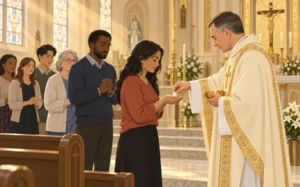
The Eucharist is not only a personal encounter between the individual believer and Christ. It is also a communal act that builds, expresses, and deepens the unity of the entire Church. This communal dimension is one of the most overlooked reasons why the Eucharist is important, and one of the most beautiful.
“Is not the cup of thanksgiving for which we give thanks a participation in the blood of Christ? And is not the bread that we break a participation in the body of Christ? Because there is one loaf, we, who are many, are one body, for we all share the one loaf.” — 1 Corinthians 10:16-17
Paul makes a stunning theological claim here: the unity of the Church is not merely organizational or sentimental. It is eucharistic. The one loaf shared by many people creates, in a real sense, one body. The people of God are constituted as one by their shared participation in the Body and Blood of Christ.
This is why the Mass brings together people of every background, language, nation, and circumstance. A Mass celebrated in Rome and a Mass celebrated in rural Kenya are the same sacrifice. The same Christ is present. The same prayer is offered. The same Communion is received. Catholics scattered across the globe are united not just by shared beliefs or shared leadership, but by shared participation in the one Eucharistic Body of Christ.
The word communion itself expresses this dual dimension: com (with) + unus (one). To receive Communion is to enter into ‘oneness with.’ Oneness with Christ. And through Christ, oneness with every other member of His Body throughout the world.
Vatican II’s Lumen Gentium described the Eucharist as the sign and instrument of the Church’s unity (LG 11). Where the Eucharist is celebrated, the Church is most fully herself. Divisions, grievances, and social distinctions that separate human beings in ordinary life are meant to dissolve at the altar. In the words of the ancient prayer before Communion: “May all of us who share in the body and blood of Christ be brought together in unity by the Holy Spirit.”
Reason 5: The Promise of Eternal Life — Bread for the Journey
The fifth and most ultimate reason the Eucharist is important is the promise attached to it by Jesus Himself: the promise of resurrection and eternal life. No human institution, no philosophy, no achievement can offer what the Eucharist offers. Only Christ, through the sacrament He instituted, makes this promise.
“Whoever eats my flesh and drinks my blood has eternal life, and I will raise them up at the last day. For my flesh is true food and my blood is true drink.” — John 6:54-55
This passage is part of what theologians call the Bread of Life Discourse in John chapter 6. Jesus speaks this teaching in the synagogue at Capernaum, to an audience that finds His words shocking. Many disciples walk away. He does not call them back by softening His language or explaining that He was speaking metaphorically. He lets them leave. Then He turns to the Twelve and asks: “Do you also want to leave?” Peter answers for them all: “Lord, to whom shall we go? You have the words of eternal life.” (John 6:67-68)
The Eucharist is what the Church has always called viaticum (from the Latin for provision for a journey) when given to the dying. It is the final earthly food before eternal life. But it is not only for the dying. Every reception of the Eucharist is, in a sense, a foretaste of heaven: a moment where the eternal breaks into time, where the glorified Christ enters the material world through consecrated bread and wine.
The Catechism describes the Eucharist as “a pledge of future glory” (CCC 1402), anticipating the Wedding Banquet of the Lamb described in Revelation 19:9. Catholics who receive Communion are not merely performing a ritual. They are participating in the beginning of the resurrection life that will reach its fullness at the end of time.
“Blessed are those who are invited to the wedding supper of the Lamb.” — Revelation 19:9
This is the ultimate horizon of the Eucharist. Every Mass is a foretaste of eternity. The Bread of Life given at every altar across the world is the same Body that rose from the grave on Easter morning, and the same Body that will call every faithful soul from the grave at the last day.
What Is the Eucharist? Definition and Meaning
For those new to Catholic theology, a brief clarification is helpful.
Eucharist definition: The Eucharist (from the Greek eucharistia, meaning thanksgiving) is the sacrament instituted by Jesus Christ at the Last Supper in which, through the words of consecration spoken by an ordained priest, bread and wine become the Body, Blood, Soul, and Divinity of Christ. It is also called Holy Communion, the Blessed Sacrament, the Mass, and the Lord’s Supper.
What does the word Eucharist mean? The word derives directly from the Greek eucharistia, which means ‘thanksgiving’ or ‘gratitude.’ Jesus ‘gave thanks’ (eucharistesas) before breaking the bread at the Last Supper (Matthew 26:27; Luke 22:17). The name reflects the nature of the sacrament as humanity’s greatest act of thanksgiving to God.
Where does the word Eucharist come from? The term entered Christian vocabulary through the earliest Greek-speaking Christian communities. Saint Justin Martyr used the word eucharistia to describe the celebration of the Lord’s Supper as early as approximately 155 AD, just over a century after the Resurrection.
Eucharist Meaning and Significance: A Summary
Here is a summary of the key dimensions of Eucharistic meaning and significance in Catholic faith:
| Dimension | Significance |
| Real Presence | Jesus Christ is truly present, Body, Blood, Soul, and Divinity, under the appearances of bread and wine |
| Sacrifice | The Mass makes present the one sacrifice of Christ on Calvary, not repeated but re-presented across time |
| Communion | Receiving the Eucharist creates direct spiritual and physical union between Christ and the believer |
| Forgiveness | Regular reception cleanses venial sins and strengthens the soul against future sin |
| Community | Shared reception makes the many into one Body of Christ, uniting the universal Church |
| Eternal Life | Christ promised resurrection and eternal life to those who eat His flesh and drink His blood |
Is the Eucharist Biblical?
Yes. The Eucharist is grounded in multiple passages across both the Gospels and the Epistles. The four core scriptural foundations are:
- The Last Supper accounts: Matthew 26:26-28, Mark 14:22-24, Luke 22:19-20. All three Synoptic Gospels and Saint Paul (1 Corinthians 11:23-25) record Jesus instituting the Eucharist, identifying the bread as His body and the cup as His blood of the covenant.
- The Bread of Life Discourse: John 6:51-58. Jesus declares Himself the living bread come down from heaven and commands His followers to eat His flesh and drink His blood for eternal life.
- The Emmaus encounter: Luke 24:30-35. The risen Christ is recognized by His disciples specifically in the breaking of bread, a term the early Church used specifically for the Eucharist.
- Saint Paul on the Body and Blood: 1 Corinthians 10:16-17 and 11:23-29. Paul teaches that the cup and bread are a true participation in the blood and body of Christ, and warns that unworthy reception brings judgment.
The Eucharist does not appear in Scripture as an afterthought. It runs through the New Testament as one of its central themes, from the institution at the Last Supper through the life of the early Church described in Acts 2:42, where the breaking of bread was one of the four defining practices of the first Christian community.
Frequently Asked Questions
Why is the Eucharist so important?
The Eucharist is so important because it is, in Catholic teaching, the actual Body and Blood of Jesus Christ. Receiving it creates direct union with Christ, forgives venial sin, unites the faithful as one Body, and fulfills Jesus’s promise of eternal life. It is not merely a ritual but a genuine encounter with the living God.
What does the Eucharist mean in the Catholic Church?
In the Catholic Church, the Eucharist is the central sacrament of the faith. It is the offering of the sacrifice of Christ made present on the altar, and the reception of His Body and Blood by the faithful. The Church calls it the “source and summit” of Christian life because all other sacraments and spiritual practices flow from and lead back to the Eucharist.
What does the word Eucharist mean?
The word Eucharist comes from the Greek eucharistia, meaning thanksgiving. It refers to the act of giving thanks that Jesus performed at the Last Supper before distributing the bread and cup to His disciples.
What does the Catholic Church believe about the Eucharist?
The Catholic Church believes that the bread and wine at Mass are truly changed into the Body and Blood of Christ through the doctrine of transubstantiation. Christ is present not symbolically but actually, Body, Blood, Soul, and Divinity, under the appearances of bread and wine. This teaching has been held since the earliest centuries of the Church.
What happens during the Eucharist?
During the Eucharist, an ordained Catholic priest prays the words of consecration over the bread and wine, the same words Jesus used at the Last Supper. The Catholic Church teaches that at this moment, the substance of the bread and wine is entirely transformed into the Body and Blood of Christ. The congregation then receives Holy Communion, entering into direct union with Christ.
What is the body of Christ made of in the Eucharist?
In the Eucharist, what appears to be ordinary bread and wine is taught by the Catholic Church to be the actual Body and Blood of Christ. The outward appearances (accidents) of bread and wine remain, but the substance has been entirely transformed. This is the teaching of transubstantiation, defined by the Council of Trent in 1551.
What do Catholics call communion?
Catholics use several terms for this sacrament: Holy Communion, the Eucharist, the Blessed Sacrament, the Body and Blood of Christ, and the Holy Sacrifice of the Mass. The term “communion” emphasizes the union with Christ and with the Church that the sacrament creates.
Is the Eucharist the same as communion?
Yes. Communion and the Eucharist refer to the same sacrament. “Eucharist” is the broader term for the entire sacramental celebration including the Mass. “Communion” or “Holy Communion” typically refers specifically to the act of receiving the Body and Blood of Christ.
Conclusion
The 5 reasons why the Eucharist is important come down to this: it makes Christ truly present, it creates the deepest possible union between the soul and God, it offers forgiveness and healing, it constitutes the unity of the worldwide Church, and it fulfills the promise of eternal life.
These are not five separate ideas. They are five dimensions of one reality: the presence of Jesus Christ among His people, given freely in an act of love that began at the Last Supper and continues at every altar in the world, at every Mass, every day.
Pope Benedict XVI wrote that the Eucharist is “the living heart of each and every parish.” For Catholics, it is more than that. It is the living heart of Christianity itself. To receive the Eucharist with faith, reverence, and understanding is to encounter the risen Christ as personally and as truly as the disciples who walked with Him in Galilee.
Want to go deeper into Catholic faith and teaching? Explore our related guides on 5 reasons why cursive should not be taught in schools and other topics at 5-reasonswhy.com.