


Every dog owner knows the look. The leash hangs by the door, the day gets busy, and somewhere around late afternoon a pair of hopeful eyes starts following you from room to room. Your dog is not just asking for a toilet break. He is asking for the highlight of his day.
Many owners assume that a dog with a yard, a few toys, and a full food bowl has everything he needs. The truth is different. A daily walk is not a luxury or an optional extra for energetic breeds only. It is one of the most basic needs of every dog, as fundamental as food and water. Here are 5 reasons why dogs need daily walks, and what actually happens in your dog’s body and mind when that leash comes off the hook.
Why Do Dogs Need Daily Walks? (Quick Answer)
Dogs need daily walks because walking keeps their body healthy and their weight under control, gives their brain essential mental stimulation through sniffing and exploring, burns off the energy that otherwise turns into destructive behavior, builds social skills and confidence around people and other dogs, and strengthens the bond between dog and owner. The American Kennel Club advises that most dogs need between 30 minutes and 2 hours of activity every day, depending on breed, age, and health.
Reason 1: It Keeps Their Body Healthy and Their Weight in Check
The most obvious reason is physical. Dogs were not built to lie on a rug for 23 hours a day. Their muscles, joints, heart, and digestive system all depend on regular movement to stay in working order.
Weight is the big one. Extra pounds are one of the most common and most preventable health problems vets see in pet dogs, and an overweight dog faces a higher risk of joint damage, diabetes, heart strain, and a shorter life. Daily walking is the simplest weight management tool there is. The American Kennel Club’s guidance on safe weight loss puts walking at the center of any plan, noting that while the recommended minimum is around 20 minutes of exercise twice a day, many breeds need an hour or more, and that all dogs, whatever their size, need to move.
Walking also keeps joints supple, which matters enormously for senior dogs and for breeds prone to hip and joint trouble. Regular gentle movement lubricates joints and maintains the muscle that protects them. It keeps digestion regular too, and gives your dog reliable opportunities to relieve himself, which reduces accidents and discomfort at home.
Think of the daily walk as your dog’s pension plan: small deposits of movement every single day, paying out in mobility and health for years.
Reason 2: A Walk Is Brain Food
Here is what many owners miss: a walk tires a dog’s mind as much as his muscles.
Dogs experience the world primarily through smell. Their sense of scent is tens of thousands of times more sensitive than ours, and a huge portion of their brain is devoted to processing it. When your dog stops to investigate a lamppost or a patch of grass, he is not wasting your time. He is reading the neighborhood news: who passed by, what they ate, how they felt, and what has changed since yesterday.
Veterinarians often point out that sniffing is genuine mental work, and that a walk rich in sniffing can leave a dog more contentedly tired than a longer walk at a forced march. New sights, sounds, surfaces, and smells all engage the brain, satisfy natural curiosity, and relieve the stress of a dog who spends long hours in the same four walls.
Skip the mental workout day after day and the understimulated mind finds its own entertainment, which leads directly to the next reason.

Reason 3: It Burns the Energy That Would Wreck Your Home
Ask any trainer about the most common behavior problems they see, chewing furniture, excessive barking, digging, pacing, hyperactivity, attention seeking, and a large share of them trace back to one simple cause: an under-exercised dog with energy and nowhere to put it.
Energy does not disappear when it is ignored. It leaks out sideways. The young Labrador who demolishes a sofa cushion, the terrier who barks at every sound, the herding breed who chases the children and nips at heels are not being bad. They are bored, frustrated athletes trying to do a job that does not exist in a living room.
A good daily walk drains that tank in the healthiest possible way. A dog who has walked, sniffed, and explored comes home settled, sleeps deeply, and is far easier to live with and to train. As the old saying among dog trainers goes, a tired dog is a good dog. Daily walks will not solve every behavior problem, and serious issues deserve a vet or a qualified behaviorist, but for the everyday restlessness that drives owners up the wall, the leash is very often the answer.
Reason 4: It Builds Social Skills and Confidence
A dog’s world can shrink quietly. A dog who rarely leaves the house meets the outside world only through the window or the fence, and unfamiliar people, dogs, bicycles, and traffic noises can start to look like threats. That is how nervous, reactive dogs are often made, not born.
Daily walks are controlled, ongoing socialization. On a walk your dog learns, in small safe doses, that strangers pass by without incident, that other dogs can be greeted calmly or ignored, that trucks rumble past and nothing bad happens. Each uneventful repetition builds confidence and teaches your dog how to behave in the human world.
Walks are also your best daily training classroom. Every outing is a chance to practice loose leash walking, sitting at curbs, coming when called, and focusing on you around distractions. Ten minutes of real world practice on a walk is worth more than an hour of drills in the quiet kitchen, because the walk is where the behavior actually has to work.
Reason 5: It Strengthens the Bond Between You and Your Dog
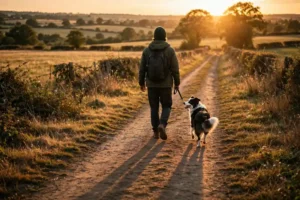
Ask dog owners what their favorite part of the day is, and a surprising number will say the walk. It is shared time with no screens, no chores, and no agenda except moving through the world together, and dogs feel that.
Walking side by side builds trust in a way few other activities can. Your dog learns to look to you for direction and reassurance in new situations, and you learn to read his body language: what delights him, what worries him, when he is tired, when he wants to play. That two-way understanding is the foundation of every well trained, deeply bonded dog.
There is a bonus, too, and it is for you. Research has found that dog owners who walk their dogs regularly take roughly 2,900 more steps per day than people without dogs, and regular dog walking is linked with better fitness and fewer health complaints. Your dog’s daily need may turn out to be the healthiest habit in your own life.
Why a Backyard Is Not Enough
One of the most common questions vets hear is: “We have a big yard, so do we still need walks?” The honest answer is yes.
A yard is the same small world, sniffed a thousand times. There are no new smells arriving, no strangers to watch, no route to explore, and most dogs left alone in a yard do far less exercise than their owners imagine. They sniff a little, patrol a little, and then lie by the door waiting for someone to come out. A yard is a wonderful supplement and a great place for play and toilet breaks, but as a replacement for walks it offers almost none of the physical variety, mental stimulation, or socialization that make walks so valuable.
Think of it this way: your yard is your dog’s living room. The walk is his school, gym, and social life combined.
How Much Walking Does Your Dog Actually Need?
The right amount depends on breed, age, and health. A Border Collie and a Bulldog live in different universes of energy. Use these ranges as a starting point, and always check with your vet for advice tailored to your own dog.
| Dog type | Suggested daily walking |
| Puppies | About 5 minutes per month of age, once or twice a day |
| Small and toy breeds | 30 to 45 minutes |
| Medium breeds | 45 to 90 minutes |
| Large and high-energy breeds | 60 minutes to 2 hours or more |
| Senior dogs | 15 to 45 minutes, shorter, gentler, but consistent |
For puppies, the 5 minute rule from the AKC’s puppy exercise guidance protects growing bones and joints, and jogging with a young dog should wait until he is fully grown, which can take up to 18 to 24 months in giant breeds. Two shorter walks suit most dogs better than one long march, and consistency matters more than intensity: a daily half hour does far more good than a single exhausting weekend hike. For a fuller guide to tailoring exercise to your dog, Pets4Homes’ advice on walking and exercise is worth a read.
How to Make Every Walk Count
- Let your dog sniff. Build sniff stops into every walk rather than dragging your dog past every interesting smell. Those pauses are his mental workout, not a delay.
- Vary the route. New streets and parks bring new smells, surfaces, and sights. Rotating two or three routes keeps walks interesting for both of you.
- Keep it consistent. Walk at roughly the same times each day. Dogs thrive on routine, and a predictable walk reduces anxiety and demand barking at the door.
- Use the walk for training. Reward loose leash walking, practice sits at crossings, and call your dog back to you for a treat now and then. Short, cheerful practice beats long drills.
- Watch the weather and the ground. In hot weather, walk early or late, carry water, and check pavement temperature with your hand; hot asphalt burns paws. In cold weather, senior and short coated dogs may need a coat and shorter outings.
Frequently Asked Questions
How long should I walk my dog each day?
Most healthy adult dogs do well with 30 minutes to 2 hours of walking per day in total, depending on breed, age, and fitness. The AKC suggests a minimum of about 20 minutes twice a day, with many breeds needing an hour or more. When in doubt, start where your dog is comfortable and build up gradually, and ask your vet what suits your dog.
Is one walk a day enough for a dog?
For some small, senior, or low-energy dogs, one good walk plus toilet breaks and play at home can be enough. For most dogs, two walks a day, even if one is short, works better: it splits the day, provides a morning and evening outlet for energy, and matches most dogs’ natural rhythm. Puppies and young dogs usually need the two-walk pattern most of all.
Can I skip walks if I have a big yard?
A yard is not a substitute for walks. It offers toilet access and space to play, but almost no new smells, socialization, or structured exercise, and most dogs are surprisingly inactive when left alone in a yard. Keep the yard for play and breaks, and keep the daily walk for everything else your dog needs.
What if my dog pulls on the leash or seems to hate walks?
Pulling usually means excitement, not disobedience, and it improves with consistent loose leash training and the right equipment, such as a well fitted harness. A dog who seems to hate walks may be fearful, in pain, or uncomfortable with the route or weather; go slowly, keep early walks short and pleasant, and see your vet if reluctance is new or sudden, since pain is a common hidden cause.
Do small dogs really need daily walks?
Yes. Small dogs have the same needs for movement, sniffing, and socialization as big dogs, and they are just as prone to weight gain and boredom behaviors, sometimes more so because owners tend to carry them. A Chihuahua’s walk may be shorter than a Labrador’s, but skipping it altogether because a dog is small is a mistake.
Conclusion
Strip away all the science and the training talk, and the daily walk is simply this: the moment each day when your dog gets to be fully a dog. He moves, he sniffs, he explores, he meets the world, and he does it all beside the person he loves most.
The benefits run in every direction. A walked dog is healthier in body, calmer in mind, better behaved at home, braver out in the world, and closer to you. The investment is modest, half an hour or so a day, and the return is measured in years of health and companionship. So the next time those hopeful eyes follow you to the door, take the hint. Hook up the leash, and go.
Key takeaways: Dogs need daily walks because (1) walking keeps their body healthy and their weight in check, (2) sniffing and exploring give essential mental stimulation, (3) walks burn the energy behind most destructive behavior, (4) they build social skills and confidence, and (5) shared walks strengthen the bond between you and your dog.
Explore more helpful guides in our Pet Care.