


If your child struggles with handwriting, you may have heard a range of explanations from teachers, doctors, and well-meaning relatives. Maybe it’s laziness. Maybe they just need more practice. Maybe they need to try cursive instead of print. Or maybe they need to skip handwriting altogether and just type everything.
None of those answers is reliably right on its own. Handwriting difficulties in children with learning differences are real, nuanced, and worth understanding properly. This guide covers what dyslexia, dysgraphia, and related conditions actually do to a child’s writing, what strategies genuinely help, and how to think about the handwriting-versus-typing decision for a child with specific learning needs.
This guide connects directly to the broader conversation about writing instruction in schools. If you want to understand how these issues relate to the cursive debate specifically, see our article on the 5 reasons why cursive should not be taught in schools and our comparison of typing vs. cursive for kids.
Quick Answer
Dyslexia primarily affects reading and phonological processing but often shows up in handwriting too, through letter reversals, inconsistent spacing, and slow output. Dysgraphia is a distinct condition that specifically impairs written expression and fine motor coordination. Children with either condition need targeted strategies, not just more practice. For many, keyboarding should be introduced early and treated as a legitimate accommodation, not a last resort.
Understanding the Conditions
What Is Dyslexia?
Dyslexia is primarily a language-processing condition. It affects how the brain decodes sounds and links them to letters, which is why reading and spelling are the most visible challenges. However, dyslexia often affects handwriting too. Common signs in a child’s writing include:
- Reversing letters such as b and d, p and q
- Inconsistent letter sizing and spacing
- Leaving out letters or words in sentences
- Slow, labored writing despite understanding the content
- Mixing print and cursive letters in the same word
These are not signs of carelessness. They reflect how the dyslexic brain processes and reproduces written symbols.
What Is Dysgraphia?
Dysgraphia is a specific learning disability that affects written expression and fine motor coordination. A child with dysgraphia may have perfectly normal reading ability but struggle significantly with the physical act of writing. Signs include:
- Poor pencil grip that causes hand pain or fatigue
- Inconsistent or illegible letter formation
- Difficulty staying on a line or within margins
- Mixing upper and lower case letters inconsistently
- Taking much longer than peers to complete written tasks
- Losing their train of thought because the physical writing is so demanding
Dysgraphia is different from dyslexia, but the two often co-occur. According to research published in the National Institutes of Health, when dyslexia and dysgraphia appear together, children face compounding challenges that require addressing both conditions simultaneously.
What About ADHD?
Children with ADHD frequently have handwriting difficulties too, but for different reasons. The challenge is often sustained attention and impulse control rather than motor coordination. Their writing may be legible when they slow down but becomes rushed and inconsistent under time pressure. Many ADHD strategies for handwriting overlap with dysgraphia strategies, particularly around reducing the physical demands of writing so the child can focus on ideas.
Does Cursive Help or Hurt?
This is a genuinely contested question, and the honest answer is: it depends on the child.
The argument for cursive with dyslexic learners: Some occupational therapists and Orton-Gillingham practitioners advocate cursive for students with dyslexia. Their reasoning is that cursive reduces letter reversals (b and d look quite different in cursive), the connected flow of cursive creates the word as a single unit which can support spelling memory, and some children find the rhythm of cursive easier than the start-stop motion of print.
The argument against: The Yale Center for Dyslexia has found that when students with dyslexia switch to keyboarding, their written output increases substantially in volume, clarity, and spelling accuracy. Forming connected cursive letters is a complex fine motor task that adds physical burden on top of an already demanding cognitive process. For children with dysgraphia especially, cursive instruction can cause anxiety, frustration, and lost learning time.
The practical middle ground: There is no single right answer across all children with learning differences. What matters is watching your specific child. If a child is making progress with cursive and finds it natural, continue. If they are struggling after reasonable time and instruction, do not keep pushing cursive. Move to print, or move to keyboarding.
Strategies That Actually Help
At Home: Building Fine Motor Foundations
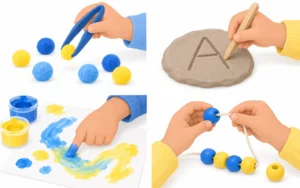
Fine motor strength underlies all handwriting. Before worrying about letter formation, build the physical foundation:
- Pinching games: Use tweezers, children’s chopsticks, or ice tongs to pick up small objects. This strengthens the muscles used in pencil grip.
- Clay and sensory surfaces: Rolling clay, etching letters into a clay-covered tray, or tracing in a shallow layer of sand gives the brain tactile feedback about letter shape that paper alone does not.
- Cutting and threading: Activities like cutting along lines, beading, and Lego construction all develop the hand coordination that writing requires.
- Finger painting and art: These are not just fun. They build the control and spatial awareness that translate directly into writing ability.
For Letter Formation Specifically
- Use wide-ruled paper and larger pencils to reduce the precision required
- Practice tracing over letters before writing independently
- Focus on frequently reversed letters in pairs: write b and d together so the contrast is visible
- Keep practice sessions short (10 to 15 minutes) to avoid fatigue and frustration
- Celebrate legibility over speed. A slow, clear letter is a success.
When to Introduce Keyboarding
For children with dysgraphia, keyboarding is not a fallback. It is a legitimate accommodation that should be introduced early. A good rule of thumb: if a child is spending more mental energy on the physical act of writing than on the ideas they are trying to express, it is time to bring in keyboarding.
For older children and teens, typing should be treated as a standard tool, not a special accommodation. Spell-check, voice-to-text, and note-taking apps are all reasonable supports. The goal is getting ideas out of a child’s head and onto paper (or screen) in a way that works for their brain.
Working With Schools

Know Your Child’s Rights
In the United States, children with diagnosed learning disabilities including dyslexia and dysgraphia may be entitled to accommodations under the Individuals with Disabilities Education Act (IDEA) or Section 504 of the Rehabilitation Act. These accommodations can include:
- Extended time on written assignments and tests
- Permission to type rather than write by hand
- Access to speech-to-text software
- Reduced copying requirements
- Preprinted notes or fill-in-the-blank formats
If your child does not yet have a formal diagnosis but you suspect a learning difference, talk to their teacher and ask for a referral to the school’s special education team for an evaluation.
What to Ask Teachers
When meeting with your child’s teacher about handwriting concerns, useful questions include:
- What specific handwriting behaviors are you seeing that concern you?
- Is this child being assessed on the quality of their handwriting, or on the ideas they are expressing?
- What accommodations does the school currently offer for students with writing difficulties?
- Would an occupational therapy referral be appropriate?
The Typing Question: When Is It the Right Call?
For most children with dyslexia or dysgraphia, the sequence should look like this:
- Build fine motor skills through play and hands-on activities from early childhood
- Introduce print handwriting with appropriate supports and accommodations
- Begin keyboarding early (ages 6 to 8) alongside handwriting
- Make keyboarding the primary writing tool for longer assignments by ages 9 to 10
- Introduce cursive only if required by school or if the child specifically wants to learn it
The goal is never to eliminate handwriting entirely. Writing by hand still supports memory and cognitive development, and many children with learning differences find journaling or free writing by hand to be therapeutic. The goal is to make sure that handwriting demands are not standing between a child and their ability to express what they actually know and think.
For a full comparison of how typing and handwriting serve different needs at different ages, see our guide on typing vs. cursive for kids. And for how digital literacy fits into the bigger picture, explore our parent’s guide to digital literacy for elementary students.
Frequently Asked Questions
How do I know if my child has dysgraphia and not just poor handwriting?
Poor handwriting that improves with practice and maturity is normal. Dysgraphia is persistent, causes significant hand pain or fatigue, affects a child’s ability to complete written work at a pace comparable to peers, and does not fully resolve with standard instruction. A formal evaluation by a psychologist or occupational therapist is the most reliable way to know.
Should children with dyslexia avoid cursive?
Not necessarily. Some children with dyslexia do better with cursive because the connected letter forms reduce reversals. However, cursive should never be forced on a child who is struggling with it. If cursive is creating anxiety or taking up too much instructional time without clear benefit, print and keyboarding are appropriate alternatives.
What is the best typing program for a child with learning differences?
Programs that are self-paced, visually simple, and game-based tend to work well. Typing.com, Dance Mat Typing (free from the BBC), and Nessy Fingers are well regarded for younger learners. For children with ADHD, shorter sessions with frequent breaks matter more than which specific program is used.
At what age should a child with dysgraphia start typing?
Earlier than you might think. Basic keyboard familiarity can start at age 6. If a child has a confirmed dysgraphia diagnosis, structured typing instruction from age 7 or 8 is a reasonable recommendation. Many specialists suggest that waiting until middle school is too late.
Can a child have both dyslexia and dysgraphia?
Yes, and it is fairly common. The two conditions affect different underlying processes (language decoding versus fine motor coordination) but often co-occur. When both are present, the challenges compound and a comprehensive evaluation is especially important.
Sources: National Institutes of Health (PMC12387373), Understood.org (dysgraphia strategies), Yale Center for Dyslexia via Ladder Learning Services, Dysgraphia.life (parent tips), Homeschooling with Dyslexia.