


Cardiopulmonary resuscitation (CPR) is one of the most critical interventions in emergency medicine. According to the American Heart Association (AHA), CPR can double or triple a cardiac arrest victim’s chance of survival when administered promptly and correctly. But knowing when to start CPR is only half the equation. Knowing when to stop CPR is equally essential, clinically, ethically, and legally.
For healthcare providers, EMS personnel, and trained lay rescuers, the decision to discontinue resuscitation is one of the most difficult calls in emergency care. It requires balancing the patient’s best interests, the likelihood of meaningful survival, legal directives, and in some cases, the safety of everyone on scene.
This guide outlines the 5 clinically recognized reasons to stop CPR, aligned with the AHA 2025 Guidelines for CPR and Emergency Cardiovascular Care (ECC), StatPearls clinical protocols, and established Termination of Resuscitation (TOR) rules.
Quick Answer: When Should You Stop CPR?
You should stop CPR when: (1) there are obvious clinical signs of irreversible death such as rigor mortis or decapitation, (2) the patient has fatal injuries incompatible with survival, (3) a valid Do-Not-Resuscitate (DNR) order or advance directive is present, (4) Return of Spontaneous Circulation (ROSC) is achieved, or (5) prolonged CPR has produced no ROSC and no reversible cause has been identified after the appropriate resuscitation interval. Scene safety threats that endanger the rescuer also justify stopping or not initiating CPR.
5 Reasons to Stop CPR: Quick Reference Table

The table below provides a fast clinical reference for CPR discontinuation decisions, aligned with AHA and EMS protocol guidance:
| # | Reason | Clinical Indicators | Action |
| 1 | Obvious Signs of Irreversible Death | Rigor mortis, livor mortis, decapitation, decomposition | Do not initiate or immediately discontinue CPR |
| 2 | Fatal Injuries Incompatible With Life | Decapitation, transection, complete incineration | CPR is medically futile — do not initiate |
| 3 | Valid DNR / Advance Directive | DNR order, POLST, healthcare proxy | Honor directive — do not perform CPR |
| 4 | ROSC Achieved | Return of pulse, breathing, responsiveness | Stop CPR — patient has circulation restored |
| 5 | Prolonged CPR Without ROSC | No ROSC after 20+ min of ALS, no shockable rhythm, no reversible cause | Consider termination per TOR protocols |
| Bonus | Scene Safety Threat | Fire, structural collapse, violence, electrical hazard | Evacuate — rescuer safety takes priority |
Each of these reasons is explained in full clinical and practical detail in the sections below.
Reason 1: Obvious Clinical Signs of Irreversible Death
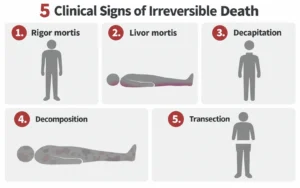
The clearest and most universally accepted reason to stop CPR, or to not initiate it at all, is the presence of obvious clinical signs that confirm irreversible biological death. When these signs are present, CPR is not only futile but medically inappropriate.
According to StatPearls (NCBI/NIH), CPR should not be performed when unmistakable signs of irreversible death are present. The AHA Circulation guidelines on ethics confirm this directly: CPR for a patient who has suffered irreversible death is an inappropriate and futile intervention.
Clinical Signs That Indicate Irreversible Death
- Rigor mortis: The stiffening of body muscles that begins approximately 2 hours after death due to the depletion of ATP (adenosine triphosphate). Once rigor is present and confirmed, CPR cannot restore circulation to a viable state.
- Livor mortis (dependent lividity): The purplish discoloration of skin caused by the gravitational pooling of blood in the lowest body parts after the heart stops circulating blood. Fixed lividity indicates death occurred well before arrival.
- Decapitation: Separation of the head from the body. No resuscitation is clinically appropriate.
- Transection: Severing of the body at the torso. Cardiac output cannot be restored.
- Decomposition: Visible breakdown of body tissue, indicating death occurred hours to days prior.
- Incineration: Extensive burning incompatible with survival.
EMS protocols across jurisdictions, including Marin County EMS and CHEMS Field Treatment Guidelines, specifically list these signs as criteria under which CPR may be withheld and death declared on scene without transport to hospital.
It is critical to note that these signs must be unambiguous and confirmed. In cases of hypothermia, drowning, or lightning strikes, for example, similar-looking presentations can be reversible and full resuscitation efforts should be initiated regardless of initial appearance.
Reason 2: Injuries Incompatible With Life (Obvious Fatal Trauma)
A second reason to stop CPR, or to withhold it entirely, is the presence of injuries that are obviously incompatible with survival regardless of resuscitation efforts. This is closely related to Reason 1 but applies specifically to acute traumatic presentations where death is the direct and unavoidable result of the physical injury sustained.
According to NIH StatPearls on EMS Termination of Resuscitation, overt clinical signs that indicate fatal trauma include decapitation, transection, and injuries where no physiologically plausible pathway to ROSC exists. The CHEMS Field Treatment Guidelines note that in blunt and penetrating trauma, if the patient is apneic, pulseless, and without other signs of life upon EMS arrival, resuscitation may appropriately be withheld.
Examples of Injuries Incompatible With Life
- Complete decapitation or transection of the torso
- Massive open cranial injuries with brain matter extrusion
- Full-body incineration
- Catastrophic hemorrhage with complete exsanguination confirmed on scene
- Penetrating cardiac trauma with no signs of life on EMS arrival and no organized cardiac activity
It is important that this determination be made carefully and by appropriately trained personnel. The AHA 2025 ethics guidelines note that conditions such as irreversible brain damage cannot be reliably assessed or predicted at the time of cardiac arrest. Only injuries that are objectively and visibly incompatible with any survival justify withholding CPR on this basis alone.
Note for lay rescuers: If you are not a trained medical professional, do not attempt to make this determination. Begin CPR and wait for EMS. The judgment of whether injuries are incompatible with life belongs to trained providers operating under medical director oversight.
Reason 3: A Valid Do-Not-Resuscitate (DNR) Order or Advance Directive
One of the most legally and ethically significant reasons to stop CPR is the presence of a valid advance directive that expressly declines resuscitation. Performing CPR on a patient who has legally documented their refusal of resuscitation violates that patient’s autonomy and right to self-determination.
According to the AHA 2025 Ethics Guidelines (Circulation), valid reasons to withhold resuscitation include: a valid, signed, and dated advance directive indicating that resuscitation is not desired, or a valid, signed, and dated DNAR (Do Not Attempt Resuscitation) order.
Legal Documents That Must Be Honored
- DNR (Do Not Resuscitate) order: A physician-signed medical order indicating that no resuscitation should be attempted if the patient suffers cardiac or respiratory arrest. This is the most commonly recognized form.
- POLST (Physician Orders for Life-Sustaining Treatment): A more detailed medical order form that covers a range of life-sustaining treatments, including CPR. POLST forms are recognized in most U.S. states.
- Advance Directive / Living Will: A legal document in which a patient specifies their wishes regarding medical treatment, including CPR, if they become unable to communicate.
- Healthcare Power of Attorney / Healthcare Proxy: A designated individual authorized to make medical decisions on behalf of a patient who cannot speak for themselves. If the proxy confirms a DNR exists and presents documentation, this must be honored.
Important clinical notes:
- The document must be valid: signed, dated, and consistent with the jurisdiction’s legal requirements. An undated or unsigned DNR does not carry legal force.
- EMS providers must be familiar with their jurisdiction’s out-of-hospital DNR protocols. These vary by state and country.
- If there is any doubt about the validity or authenticity of a DNR, the standard of care is to initiate CPR and contact medical oversight immediately.
- Verbal reports of a DNR from family members, without documentation present, are generally not sufficient to withhold CPR in the prehospital setting. Contact online medical direction if possible.
Important: If you discover a DNR after initiating CPR, stop CPR as soon as the document is verified as valid. The AHA guidelines confirm that withholding resuscitation and discontinuation of life-sustaining treatment during resuscitation are ethically equivalent.
Reason 4: Return of Spontaneous Circulation (ROSC) Has Been Achieved
This is the most clinically desirable reason to stop CPR. Return of Spontaneous Circulation (ROSC) means the patient’s heart has resumed beating on its own, restoring blood flow without the assistance of chest compressions. When ROSC is achieved, continuing CPR would be both unnecessary and potentially harmful.
ROSC is the primary goal of all resuscitation efforts. According to LITFL (Life in the Fast Lane), survival from cardiac arrest is highly dependent on time to defibrillation and return of spontaneous circulation. Research from the Netherlands has highlighted that survival decreases markedly with delays in ROSC, underscoring why achieving it quickly is the core objective of the entire resuscitation effort.
Clinical Signs of ROSC
- Palpable pulse: A central pulse (carotid or femoral) is the primary confirming sign of ROSC.
- Spontaneous breathing: The patient begins breathing independently, though this alone does not confirm ROSC.
- Purposeful movement: The patient moves, coughs, or responds to stimulation.
- Rising ETCO2: End-tidal CO2 monitoring, used in advanced resuscitation settings, shows an upsurge in ETCO2 values. The AHA guidelines note that an increase in ETCO2 may identify ROSC before it is clinically detectable.
- Return of blood pressure: In monitored patients, a measurable blood pressure indicates restored cardiac output.
After confirming ROSC, the resuscitation team shifts focus to post-cardiac arrest care, including targeted temperature management, hemodynamic stabilization, and transfer to an appropriate facility for continued monitoring and management.
Important: ROSC confirmation requires that compressions be paused briefly to assess pulse. The AHA recommends minimizing interruptions to chest compressions and that rhythm and pulse checks occur no more frequently than every 2 minutes during active resuscitation.
Reason 5: Prolonged CPR Without ROSC and No Reversible Cause Identified
The fifth and most clinically complex reason to stop CPR is the failure to achieve ROSC after a prolonged resuscitation effort when no reversible cause has been identified. This is the domain of the Termination of Resuscitation (TOR) rules and requires careful clinical judgment, medical director oversight, and protocol adherence.
According to LITFL’s clinical summary, the general clinical benchmark is: no response to Advanced Cardiac Life Support (ACLS) after 20 minutes of efficient resuscitation in the absence of ROSC, a shockable rhythm, or reversible causes. For asystole specifically, 20 minutes of asystole is generally considered non-survivable in most clinical and EMS protocols.
The Basic Life Support (BLS) Termination of Resuscitation Rule
The BLS TOR Rule, developed by Morrison et al. (2006) and validated in subsequent studies including a 2021 retrospective study published by the NIH, recommends considering termination of resuscitation for non-traumatic out-of-hospital cardiac arrest when ALL three criteria are met:
- The cardiac arrest was NOT witnessed by EMS personnel
- No shocks were delivered by an AED or defibrillator
- No ROSC was achieved despite resuscitation efforts
When all three criteria are present, survival rates are extremely low and transport to hospital rarely improves outcomes. Many EMS systems have incorporated these TOR rules into their protocols under medical director oversight.
Factors That Argue AGAINST Stopping CPR (When Not to Stop)
The decision to terminate resuscitation must always account for factors that suggest a chance of meaningful survival remains. These include:
- Hypothermia: “No one is dead until they are warm and dead” is a well-established clinical principle. Patients with severe hypothermia may appear dead but be resuscitable with appropriate warming.
- Drowning: Particularly cold-water drowning in younger patients. The AHA guidelines provide specific resuscitation guidance for drowning victims that differs from standard protocols.
- Drug overdose or poisoning: Cardiac arrest from certain drug toxicities may be reversible with specific antidotes or prolonged resuscitation.
- Lightning strike: Survival from lightning-induced cardiac arrest is possible with aggressive resuscitation even after prolonged efforts.
- Shockable rhythm present: If ventricular fibrillation or pulseless VT is present, defibrillation remains an option and termination is generally inappropriate.
The AHA 2025 Ethics Guidelines confirm that selected patients potentially have good outcomes with prolonged, aggressive resuscitation. The default position should always be to continue resuscitation unless a clear reason to stop is present and confirmed.
Clinical Note: In the prehospital setting, termination of resuscitation decisions require contact with online medical direction in most jurisdictions. A provider should not unilaterally terminate resuscitation without authorization from a physician or medical director unless explicitly permitted by standing protocols.
Bonus Reason: Scene Safety Threats That Endanger the Rescuer
While not listed among the five primary reasons to stop CPR, scene safety represents a critical and universally recognized justification for discontinuing resuscitation. No patient outcome is worth the death or serious injury of a rescuer.
According to the AHA ethics guidelines and StatPearls EMS termination protocols, situations where CPR would place the rescuer at risk of serious injury or mortal peril are recognized grounds for withholding or stopping resuscitation. These include:
- Active fire, structural collapse, or building instability
- Ongoing violent threat (active shooter, assault in progress)
- Live electrical hazard that cannot be de-energized
- Chemical or toxic gas exposure without appropriate PPE
- Rising floodwater or unstable drowning scene
The principle is straightforward: a rescuer who becomes a second victim provides no benefit to the patient and creates an additional casualty. If scene safety deteriorates after CPR has begun, providers should move the patient to a safe location if possible, or discontinue CPR and evacuate if movement is not feasible.
How Long Should You Conduct CPR Before Stopping?
This is one of the most frequently asked questions from trained rescuers and healthcare students. There is no single universal time limit for CPR, but clinical guidelines and research provide practical guidance:
- General ACLS benchmark: 20 minutes of efficient Advanced Cardiac Life Support without ROSC, no shockable rhythm, and no reversible cause identified is the commonly cited clinical threshold for considering termination in most adult non-traumatic arrest scenarios.
- Asystole: Asystole persisting for 20 minutes in a monitored patient receiving appropriate ACLS is generally considered non-survivable. Always verify lead placement and gain settings before concluding rhythm is truly asystole.
- Neonatal resuscitation: In a newborn with no detectable heart rate remaining undetectable for 10 minutes, consideration of stopping resuscitation is appropriate per AHA neonatal guidelines.
- Lay rescuer / BLS context: If you are a lay rescuer performing CPR without AED access and alone, continue until EMS arrives, you are too physically exhausted to continue, or the scene becomes unsafe. Do not stop based on time alone.
The question “how long should you do CPR before giving up” reflects a natural concern, but the answer depends on the clinical picture: rhythm, cause, reversibility, and the presence of any TOR criteria. Time alone is not sufficient to justify stopping.
Frequently Asked Questions
When should you stop performing CPR?
You should stop CPR when obvious signs of irreversible death are present (rigor mortis, livor mortis, decapitation, decomposition), when a valid DNR or advance directive is confirmed, when ROSC is achieved, when injuries are clearly incompatible with survival, or when prolonged CPR has produced no ROSC and no reversible cause has been found after the appropriate resuscitation interval under medical director guidance.
When is it acceptable to stop CPR?
It is acceptable to stop CPR when any of the five recognized clinical criteria are met: signs of irreversible death, fatal injuries, valid DNR/advance directive, achievement of ROSC, or prolonged futile resuscitation without ROSC. Scene safety threats that endanger the rescuer also justify stopping. All decisions in the prehospital setting should ideally be made with or confirmed by online medical direction.
How long should you conduct CPR before stopping?
There is no single universal time limit. The general clinical benchmark per ACLS guidelines is approximately 20 minutes of efficient resuscitation without ROSC and without a shockable rhythm or identifiable reversible cause. Exceptions include hypothermia, drowning, drug overdose, and lightning strike, where longer resuscitation may be appropriate. For lay rescuers, continue until EMS arrives or you are physically unable to continue.
What is ROSC in CPR?
ROSC stands for Return of Spontaneous Circulation. It means the patient’s heart has resumed beating on its own, restoring blood flow without chest compressions. Signs include a palpable pulse, spontaneous breathing, purposeful movement, and in monitored patients, rising ETCO2 levels. ROSC is the primary goal of all CPR efforts and the most desirable reason to stop chest compressions.
What does a DNR mean for CPR?
A DNR (Do Not Resuscitate) order is a legally valid medical document in which a patient or their authorized representative has specified that CPR should not be performed if they suffer cardiac or respiratory arrest. Healthcare providers and EMS personnel are legally and ethically obligated to honor a valid DNR. If a DNR is discovered after CPR has started and is confirmed as valid, CPR should be stopped.
Should you stop CPR if someone is in rigor mortis?
Yes. Rigor mortis is an obvious clinical sign of irreversible death. CPR should not be initiated on a patient with confirmed rigor mortis, and if started before rigor was identified, it should be discontinued. Rigor mortis typically begins approximately 2 hours after death and is caused by the depletion of ATP in the muscles. It is a recognized criterion in EMS and clinical protocols worldwide for withholding resuscitation.
What are the 5 situations when you do not perform CPR?
CPR should not be performed when: (1) obvious clinical signs of irreversible death are present, (2) injuries are clearly incompatible with life, (3) a valid DNR or advance directive is confirmed, (4) ROSC has been achieved and the patient has a spontaneous pulse, and (5) the scene is immediately dangerous to the rescuer and the patient cannot be moved to safety.
When to stop CPR and declare death?
Declaring death is a physician’s responsibility in most jurisdictions. EMS providers can discontinue resuscitation and declare death on scene based on TOR protocols, presence of obvious death signs, or confirmed DNR orders, usually with medical director authorization. In-hospital death declaration follows institutional protocols and physician confirmation after ACLS efforts have been exhausted without ROSC.
Conclusion
The decision to stop CPR is never made lightly. It carries clinical, ethical, and emotional weight that few other decisions in emergency medicine can match. The 5 reasons to stop CPR outlined here, grounded in the AHA 2025 guidelines, StatPearls clinical protocols, and established TOR rules, provide a framework for making that decision with confidence and clarity.
To summarize: stop CPR when there are obvious signs of irreversible death, when injuries are incompatible with life, when a valid advance directive says not to resuscitate, when the patient achieves ROSC, or when prolonged resuscitation has produced no results and no reversible cause is present. Always prioritize rescuer safety, always seek medical director guidance when possible, and always document your clinical reasoning.
Proper CPR training builds not only the skills to perform compressions correctly, but the clinical judgment to know when to start and when to stop. For current CPR certification resources, visit the American Heart Association CPR and ECC Guidelines.
This article is for educational use only. Always defer to your jurisdiction’s medical director, current AHA guidelines, and your specific training certification for clinical decision-making. For current CPR certification and guidelines: cpr.heart.org.